



Implant
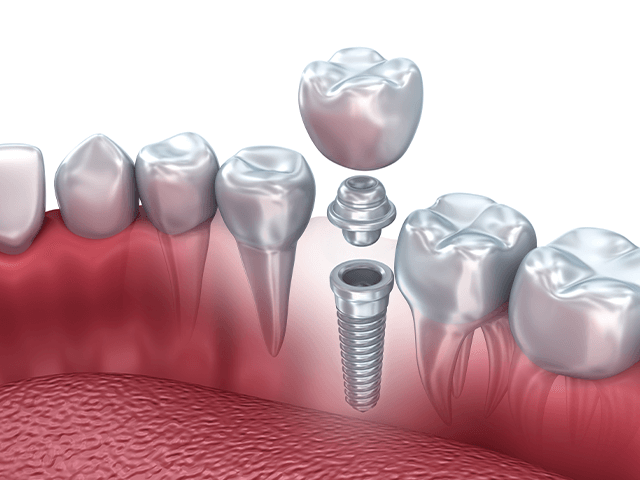
The dental implant can be expressed as the procedure of placing an artificial tooth in the missing tooth area. A screw-like metal tooth root is placed inside the jawbone and a dental prosthesis is inserted into them.
Questions such as how the implant treatment is done or does it take a long time are frequently encountered. Thanks to the development of the field of dentistry and the increase in medical innovations, this operation is performed more easily and comfortably.
What is an Implant ?
Dental implant treatment, also known as implant surgery, is artificial tooth roots and dental prostheses that replace missing teeth.
Screws are often made of either titanium or titanium-containing compounds. It is distinctive that this material is compatible with tissue and has a resistant structure. Of course, both dental implant types and brands may vary. The types of implant teeth and the talent of the dentist will have an impact on implant prices and the success of the results.
The decayed teeth are extracted (these are missing teeth) due to the delay in root canal treatment and this treatment fills these spaces. They both look like natural teeth and fulfill the functions of the original teeth.
One of its most important advantages is that it does not damage existing surrounding teeth. Contrary to popular belief, adjacent teeth do not need to be extracted. Thanks to this cutting-edge innovation that act as natural roots, the patient can speak freely, eat without difficulty and also smile as he/she wishes.
Pre-Implant Process
The consultation takes place in the first step of the question of what are the steps of implant treatment plan. The dentist examines the patient's intraoral region and jaw structure. As the patient can go to the doctor for missing teeth, this surgical intervention may be needed as a continuation of the decayed tooth extraction process. In addition, dental implants are used within the scope of All-in-4 and All-in-6.
- A detailed examination is carried out with the help of special imaging technologies. X-ray and 3D imaging can be used. The patient's medical history is evaluated.
- The patient is asked to give information about the oral treatment history. The orthodontic background story, if any, is learned. In addition, it is learned whether there are regularly used drugs and chronic diseases.
- The jawbone is examined and its suitability for the implant is evaluated. If necessary, adding bone powder is included in the plan.
- Swelling, deformation and edema in the operation area are examined. If there is such a problem, it is expected that the gum will heal first.
- The dental implant is done under anesthesia. It is mostly applied under local anesthesia. The final decision regarding this is finalized with the consensus of the anesthetist, patient, and dentist.
- The dentist informs the patient about the types of implant teeth and their prices. Also, the doctor describes in detail all the stages of the procedure.
Implant Acceptance Conditions
Dental implants are performed by oral and dental health centers, hospitals, and clinics. Whether he/she is a suitable candidate for a dental implant is determined as a result of medical examinations.
Mostly, people aged 18 and over are appropriate candidates for implant practices. Of course, the suitability of the jawbone structure is also checked. Children with ongoing bone development are not good candidates. A general health condition evaluation is asked for people with diabetes and heart disease.
Implant Treatment Process
The implant can be applied in screwed-retrained and cement-retrained forms. For the most used version, this treatment has 2 stages. Insertion of the screw-retained implant tool into the jawbone is the first step; the placement of the dental prosthesis on this metal screw is the second stage.
After the screw-like medical instrument is inserted, a temporary cap can be attached or this area can be left to heal. Then the prosthetic tooth heads are placed on the implants. The location of the implant and the number of implants is the determining factors in the treatment process.
Zirconium material is often preferred as a prosthesis. Because this material is more durable than most others, it also has a lighter color, it adapts to the body, and it does not change color or darken over time. At this point, it should be reminded that Turkey dental implants are among the best in all countries.
Post-Implant Process
If tooth extraction is required, the treatment is started after 3-4 months at the most. The time that will pass between inserting the screws into the jawbone and placing the dental prosthesis on this screw varies according to the practice to be applied.
The patient does not feel intense pain during or after the operation. There will be no severe implant side effects or complications that will force daily life. There may be swelling or bleeding in the first 24 hours, however, this problem will pass with the help of gauze. It is recommended to avoid hard chewing actions that will deform the wound.
In some cases, local pain or minor sensitivity may occur, your dentist will prescribe painkillers for this. You may be asked to use antibiotics to prevent the risk of infection in the mouth.
From the 2nd month on average, artificial teeth begin to adapt as a natural tooth form. During this medical operation, stitches can be placed in the relevant area. The patients should care about oral hygiene after the surgery.
You can get more information and you can learn details about dental implant costs by contacting Majestic Clinic, which welcomes you with its expert dentist staff and hi-tech dentistry equipment.
Frequently Asked Questions
- How long do dental implants last?
-
Dental implants can be used for life with proper oral care. Although tooth decay is not experienced on implant teeth because it is artificial, the fracture may occur due to physical impact, and high pressure.
- How Painful is Dental Implant Surgery?
-
No. Since the implant is performed under anesthesia, the patient does not feel intense pain. There may be side effects such as minor pain and swelling after the surgical intervention, but these are temporary implant complications and are not of the kind that will tire the patient.
- What should be done after the implant?
-
You should not smoke and not force the operated gum and jawbone regions but you must follow oral hygiene rules and follow all the instructions given by the doctor. The dentist may ask you to use a special toothbrush and toothpaste. In order to protect both natural teeth and implants, you should not neglect intraoral hygiene.
Contact Us
Address
Çukur Mahallesi, Tarlabaşı Bulvarı No:150/170 kat:3 no:25 Beyoğlu/İstanbul
CALL US